






Textile firefighting outfits
MATERIEL POMPIER is a manufacturer and distributor of personal protective equipment for fire, industrial and fire services.
We offer intervention clothing from category I to category III.
With our design office, we also develop personalized outfits to meet the needs of each client.

Products available
Fast delivery in France and internationally
Free delivery in France
From €400 of online purchases on the site
Free quote 24h
Contact us!
Customer Service
+334 79 34 92 15
Mobile payment
Apple & Google Pay
PRODUCTS
11 results displayed. Sorted from newest to oldest.
-
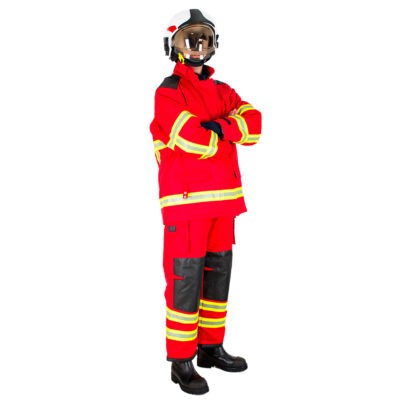
Red textile firefighters' fire suit
Price on request -
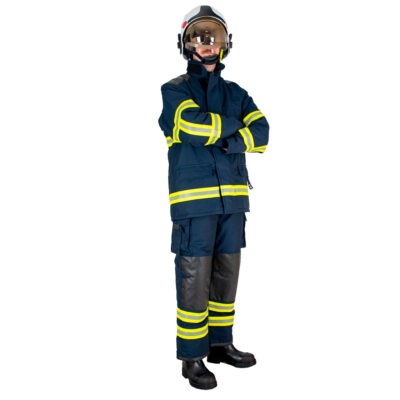
Blue textile firefighters' fire suit
1065,00€ VAT Incl. -
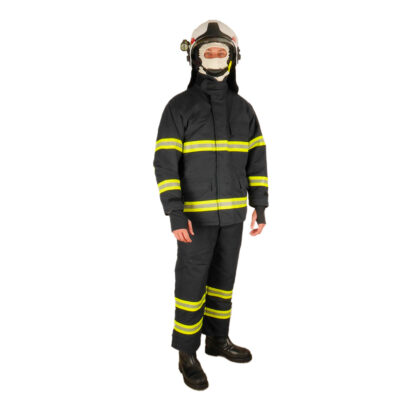 Customizable clothing
Textile fire gear for firefighters
890,00€ VAT Incl. -
 Customizable clothing
Fire Service Outfit – TSI
320,00€ VAT Incl. -

F1 firefighter intervention outfit
Price on request -
 Customizable clothing
Anti-static forest fire suit
542,00€ VAT Incl. -
 Customizable clothing
1st intervention pack – Textile fire gear for firefighters
1735,00€ VAT Incl. -
 Customizable clothing
Anti-static raincoat resistant to chemicals
340,00€ VAT Incl. -
 Customizable clothing
NOMEX lightweight protective clothing against industrial risks
459,00€ VAT Incl. -
 Customizable clothing
SAHARA textile forest fire outfit
901,00€ VAT Incl. -
 Customizable clothing
HV multi-risk work clothing
435,00€ VAT Incl.


LEARN MORE

Performance requirements for firefighter protective clothing
The EN 469: 2005 standard specifies the levels of performance requirements for protective clothing for firefighters.
It requires high performance, which is verified in 20 tests. Essentially, the standard determines 4 key values: Xf (flame), Xr (radiation), Y (impermeability) and Z (breathability).
EN 469 + A1 (2007): “Fire fighting”:
Application domain : Protective clothing for firefighters (fire fighting)
Goal : Protect firefighters during firefighting interventions and associated activities.
What does this standard consist of?
This standard makes it possible to define two levels according to the risk assessment: level 1 and level 2. Level 2 being the higher level.
It is a jacket/pants or jumpsuit covering the bust, neck, arms to the wrists and legs to the ankles.
For complete protection, additional equipment to protect the head, face, hands and feet should also be worn.
The product must meet the following requirements:
Heat transfer (flame and radiation): The sample is held above the flame or an IR spectrum and it is measured how many seconds the sample can be exposed before reaching a temperature rise of 24°C.
| Heat transfer index | Xf1 | Xf2 |
|---|---|---|
| HTI24 | 9,0 ≥ | 13,0 ≥ |
| HTI24 - HTI12 | 3,0 ≥ | 4,0 ≥ |
| Heat transfer index | Xr1 | Xr2 |
|---|---|---|
| RHTI24 | 10,0 ≥ | 18,0 ≥ |
| RHTI24 - RHTI12 | 3,0 ≥ | 4,0 ≥ |
- Resistance to water penetration, water vapor and liquid chemicals
- Flame spread
- Thermal resistance
- Tensile and tear resistance
- Dimensional variation
- Visibility (according to EN 471 (2007))
Marking
For general marking requirements, please refer to standard EN 340.

This pictogram may be accompanied by the following annotations:
Xf1 / Xf2 or Xr1 / Xr2: thermal protection (flame (f) or radiation (r))
Y1 / Y2: resistance to water penetration
Z1 / Z2: resistance to water vapor
EN 15614: 2007
Performance requirements for wildland firefighting clothing
The EN 15614:2007 standard sets out the various performance requirements that clothing worn during wildfire fighting must meet. Since wildfires occur mainly in summer, radiant heat can be very high for extended periods. Clothing conforming to this standard helps prevent metabolic heat from becoming excessive. Clothing suitable for these conditions must be lightweight and not cause heat stress.
EN ISO 15384: 2020
New performance requirements for wildland firefighting clothing
This new standard replaces standard EN 15614.
It also sets out the various performance requirements that wildland firefighting clothing must meet.
EN ISO 20471: 2013
High visibility clothing for professional use:
Interventions on roads are much more frequent than interventions on fires. To perform these tasks safely, you need high visibility clothing. This type of clothing will alert motorists that you are on the road. High visibility clothing can save lives, especially in complex environments. For example: when bad weather is added to road markings, lights of other vehicles, wet surfaces, etc.
Brigade risk analyses require that response equipment comply with EN ISO 20471:2013. There are two options for complying with this standard. First, manufacture a suit EN 469 which also complies with EN ISO 20471:2013. Second, you can wear a Class 2 vest that complies with EN ISO 20471:2013.
EN 1149-5
The European standard EN 1149-5 ensures protective clothing to prevent electrical discharges that can cause fires in an ATEX (Explosive Atmosphere) zone, an area where the risk of explosion is higher than average. Workwear adapted to the activity and the risks it may present to the worker is essential. The EN 1149-5 standard specifies the requirements for the design and materials of electrostatic discharge clothing such as hoods, caps, trousers, jackets, vests, etc., and equipment such as knee pads or insoles, for example.